
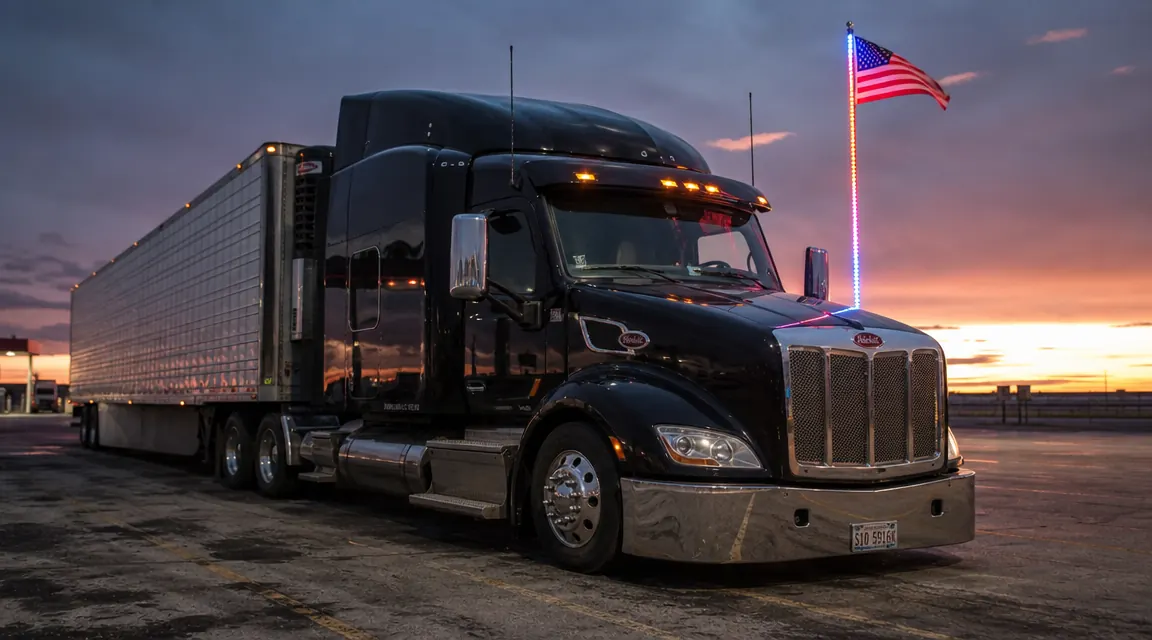
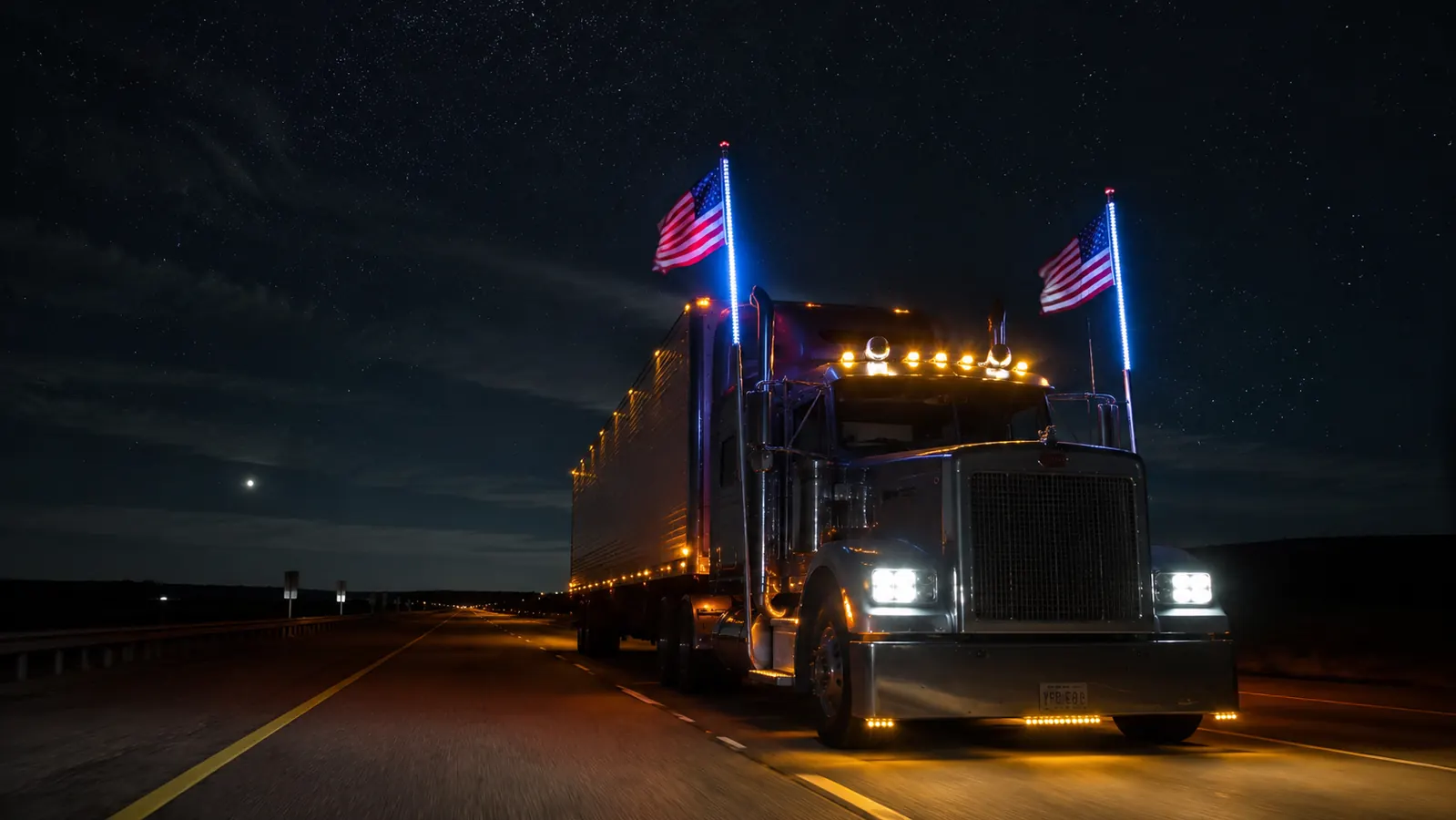
I spent 30 years behind the wheel of an 18-wheeler before I retired. Kenworths, Freightliners, Peterbilts, you name it. I flew Old Glory the whole time. But for about the first 25 of those years, once the sun went down, that flag was invisible. You could not see it from 50 feet away in the dark. That changed when LED whip lights started showing up. Now you can run the flag day and night, and the light show is honestly something to see pulling into a truck stop at 2 in the morning. People notice. Problem is, most of the install guides I've seen were written for side-by-sides and ATVs. They assume you have a roll cage to clamp to. You do not. You have a big steel cab and a lot of wind pressure at 70mph, and the mounting choices you make matter a lot more than they do on a four-wheeler doing 30 in a dune field.
This guide covers the True Mods 4ft RGB LED whip with the RF wireless remote, specifically as mounted on a Class 8 semi. I have done this install three different ways across two different trucks. I'll walk you through the right way, the tools you need, the wiring steps that keep everything tidy, and the one mistake most guys make with the remote that kills the whole experience on night one.
Running flags in the dark without an LED whip means nobody sees your colors after sundown.
The True Mods 4ft RGB LED whip comes with the RF remote and a built-in USA flag. It's the one I've run on two different rigs. Check what it's going for today before you start gathering your tools.
Amazon Check Today's Price on Amazon →Step 1: Choose Your Mounting Location Before You Buy Any Hardware
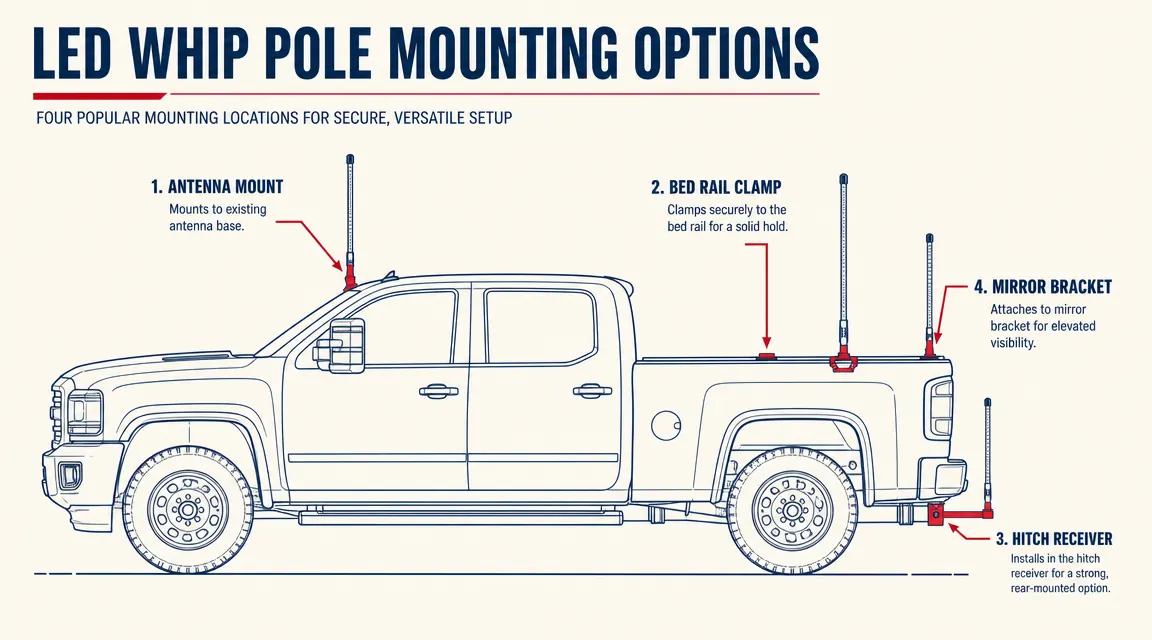
This is the step people skip, and it costs them money. On a side-by-side, you bolt the base to the roll cage. On a semi, you have four realistic options: the passenger-side mirror bracket, a threaded antenna mount on the cab roof, a 2-inch receiver hitch at the rear, or a bed-rail clamp if your truck has one. Each one has tradeoffs you need to think through before you put a dollar down on additional hardware.
The mirror bracket mount is my first choice for visibility. When you mount on the passenger side mirror arm, the whip sits up high and to the side where following drivers and four-wheelers can see it clearly. The downside is that mirror brackets are not a uniform size across manufacturers, so you may need a universal clamp adapter rated for 1.5 to 2.5 inch diameter. The antenna mount on the cab roof works well for trucks that already have a threaded antenna stub from a CB you removed. The True Mods base uses a standard 3/8-24 thread on some kits, but double-check your specific kit because this changed between production runs. Rear hitch is the easiest install if you have the receiver, but it puts the whip in a spot where only the drivers behind you get the show. Still looks great for following convoys or for lot display. If you want the full guide on hitch receiver mounts specifically, I covered that in detail over on the hitch mount install guide.
Pick your location before you do anything else. It determines your wire routing path, what adapters you need, and whether the flag position will clear your cab at speed. A 4-foot whip on a mirror bracket will sweep back at highway speed. Make sure you have clearance from the cab bodywork and that the flag material won't contact any sharp edges.
Step 2: Gather Your Tools and Check the Box
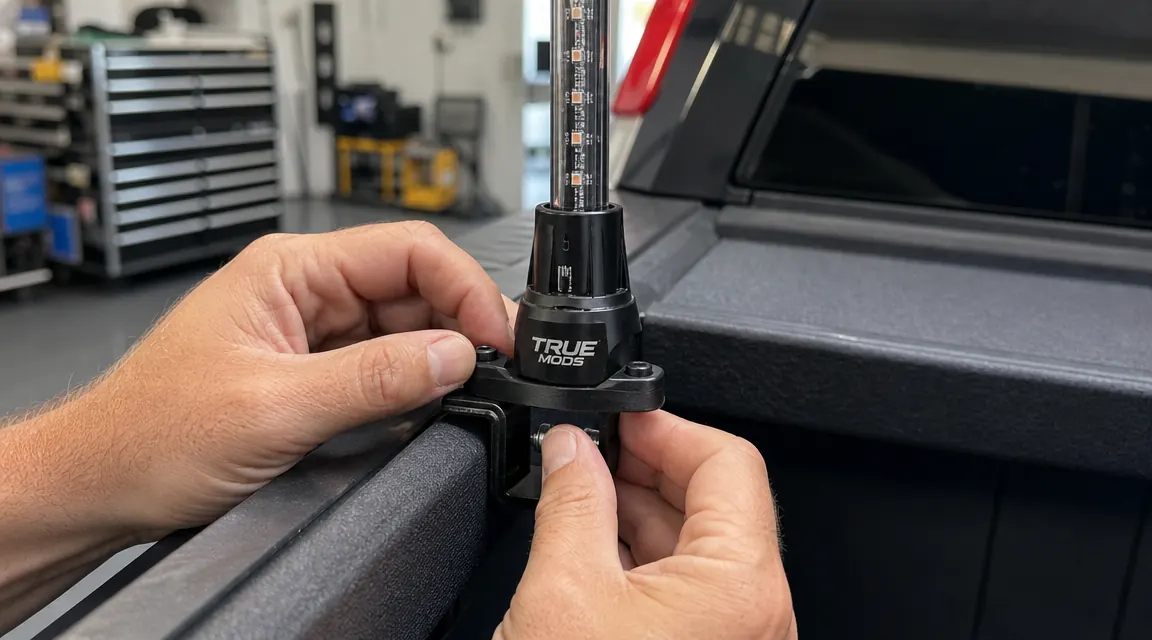
The True Mods kit ships with the whip pole, the LED strip already wound around it, the USA flag pre-attached at the top, the RF remote, a power cable with ring terminals, and a small mounting base. What it does not ship with is the hardware to attach that base to a semi truck, because True Mods designed this for UTVs and ATVs. You need to sort that out yourself based on your mounting choice from Step 1.
Tools I reach for every time: a 3/8-inch socket set, a set of combination wrenches, electrical tape, a pack of 8-inch UV-resistant zip ties, a self-tapping 10-32 screw assortment if you're going into existing holes, a rubber grommet kit for wire routing through panels, a multimeter if you want to be careful about your power source, and a flathead screwdriver for the ring terminal connections. The wire routing is low-voltage DC work, not complicated, but you want clean connections. Loose ring terminals under vibration will cause intermittent failure, and chasing an electrical gremlin on the road is miserable.
Loose ring terminals under road vibration will fail on you. Spend two minutes on the connections at the start and you won't be pulling the whole thing apart at a rest area in Kentucky at midnight.
Step 3: Mount the Base Securely
The base that comes with the True Mods is a flat-bottom disc with a center post. On a UTV, you drill through a flat surface and bolt it down. On a semi, you need an intermediate adapter to go from that base to whatever surface you've chosen. For the mirror bracket approach, I use a universal handlebar or tube clamp with a flat top plate welded or bolted to it. Machine shops near truck stops can often fab one in an afternoon for under $30. Alternatively, a number of Amazon sellers offer universal whip light flag pole mounts with U-bolt clamps designed for exactly this type of tube diameter.
Whatever hardware you use, the torque matters. I run the mounting bolts to snug plus a half-turn and then apply a small amount of blue Loctite 243 to the threads. Not red, not the permanent stuff. Blue. You want to be able to remove this without a torch. The vibration environment on a highway-speed Class 8 truck is severe. Bolts that are hand-tight will be loose inside 200 miles. Once the base is mounted, give it a firm sideways yank before you attach the whip. It should not move at all. If it flexes, tighten it further or add a secondary tie-off with a zip tie to a fixed point on the truck.
Screw the whip pole into the base finger-tight, then add one more full turn. The connection is threaded and the threads are cut well on the True Mods unit in my experience, but they're not fine threads, so don't overtighten. The pole needs to come off for certain docks, low-clearance bridges, and weigh stations where the inspector wants to look it over. Make it removable but not loose.
Step 4: Route the Power Wire Clean
The True Mods power cable exits the base and needs to reach a 12V power source. On a semi, the easiest clean source is the existing accessory tap on the cab's interior fuse panel. You'll need to route the cable from the outside mounting location through the cab wall. If you're on the mirror bracket, the wire runs down the mirror arm, along the outside of the door frame, and enters through an existing rubber grommet near the door hinges. Every cab I've worked on has at least one spare grommet on the driver or passenger door jamb that nobody is using. Feed the wire through there.
Secure the exterior wire run with zip ties every 8 to 10 inches to a fixed part of the truck frame or body. Do not let the wire run free where it can abrade against a moving part or get pinched in a door. Inside the cab, the wire terminates in two ring terminals, one positive and one negative. Connect positive to an accessory fuse slot rated at 5 amps or more, and negative to a ground point. Use a fuse tap adapter if your fuse panel has open slots. The True Mods LED whip draws well under 2 amps at full brightness, so a 5-amp fuse is plenty of protection.
One option some drivers prefer is wiring through a toggle switch mounted inside the cab so the whip can be turned on and off independently from the remote. I've done it both ways. The toggle gives you a hard off when you're in a situation where you don't want the light cycling, like a dock with tight clearance where the forklift driver is getting distracted. Worth the extra 20 minutes.
Step 5: Pair the RF Remote and Test Every Mode Before You Roll
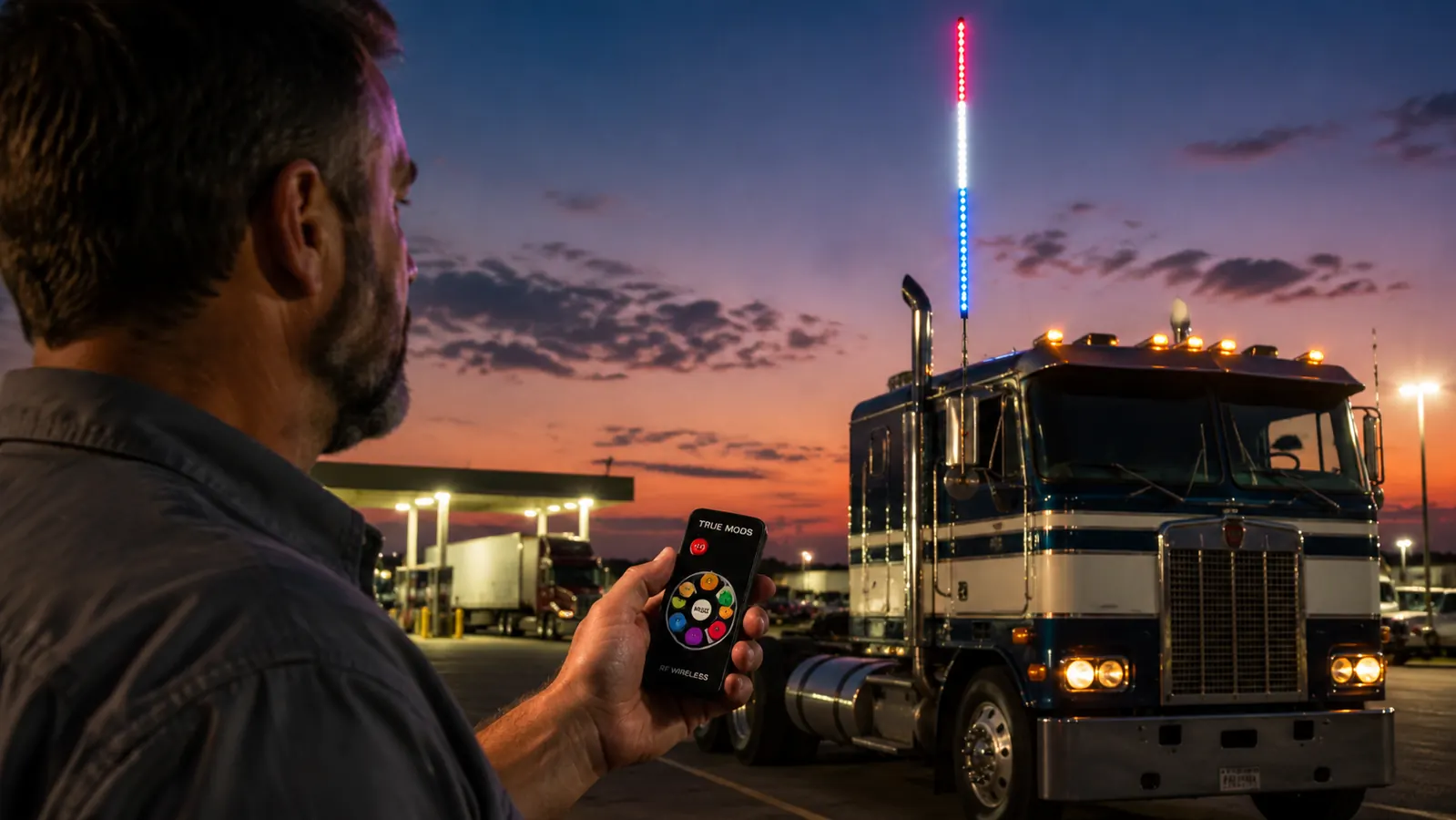
The RF remote is where most guys run into trouble. The True Mods remote operates on a 433MHz radio frequency and needs to be paired to the LED controller at the base of the whip before it will do anything. The pairing sequence is: turn on power to the whip, press and hold the mode button on the remote for 3 seconds, the LEDs will flash twice to confirm pairing. If the LEDs do not flash, cycle power off and back on and try again. I've had to do this three times on a fresh unit before it took. Patience. Once paired, the remote holds its pairing in memory, so you only do this once per install unless you replace a unit.
The remote range on the True Mods is listed at around 100 feet. In practice, through the cab, with the metal body of the truck between you and the base, I get reliable signal from the driver's seat out to about 40 to 50 feet before it gets intermittent. That is fine for turning it on and off while you're parked, but do not expect to stand 80 feet behind the truck and cycle through color modes. Keep the remote in the cab and it works every time.
Before you pull out of the lot, test all the color modes. Solid red, white, and blue for a patriotic static display. The slow pulse mode looks good during a fuel stop or overnight parking. The chase mode and strobing patterns are attention-getting but not something I run while moving because I don't want to create a distraction for other drivers on the highway. Pick a mode you're comfortable with for the road, park it there, and let it run. The True Mods LED strip is waterproof, so rain is not a concern. I drove through a hard rain on an Oklahoma run and the unit didn't skip a beat. For a full breakdown of how the unit performs over months of use, including how the LED strip holds up under constant road vibration, see my long-term review.
What Else Helps Your Flag Setup at Night
The LED whip handles light, but the flag itself matters too. The flag that ships with the True Mods unit is a small nylon piece, about 12 by 18 inches. It's decorative and it works for the LED effect, but if you want to fly a proper 3x5 Old Glory alongside the whip, you'll want a separate mount. The whip and a dedicated flagpole mount are not mutually exclusive, and some guys run both. The whip on the mirror bracket and a 3x5 flag on a hitch receiver mount is a solid combo if you want maximum visibility from all angles. Running gear matters too. White lights at the rear plus a lit whip on the side makes your truck significantly more visible to following traffic in poor conditions. That is not nothing at 70mph in rain.
Truck stop reaction is also worth mentioning because it matters to a lot of guys in this niche. You will get thumbs-ups. You will get people asking what brand the light is. Younger drivers who haven't seen one before will walk over and look at it. Veterans recognize the intent immediately. Flying Old Glory with lights after dark is as much a statement as a safety measure, and the True Mods LED whip does both jobs without making you look like you glued a disco ball to your cab.
If you're flying the flag, make sure people can see it after 6pm.
The True Mods 4ft RGB LED whip with RF remote is what I use and what I recommend. Over 2,200 reviews on Amazon and it holds up under road vibration better than most of the competition I've tried.
Amazon Check Today's Price on Amazon →