
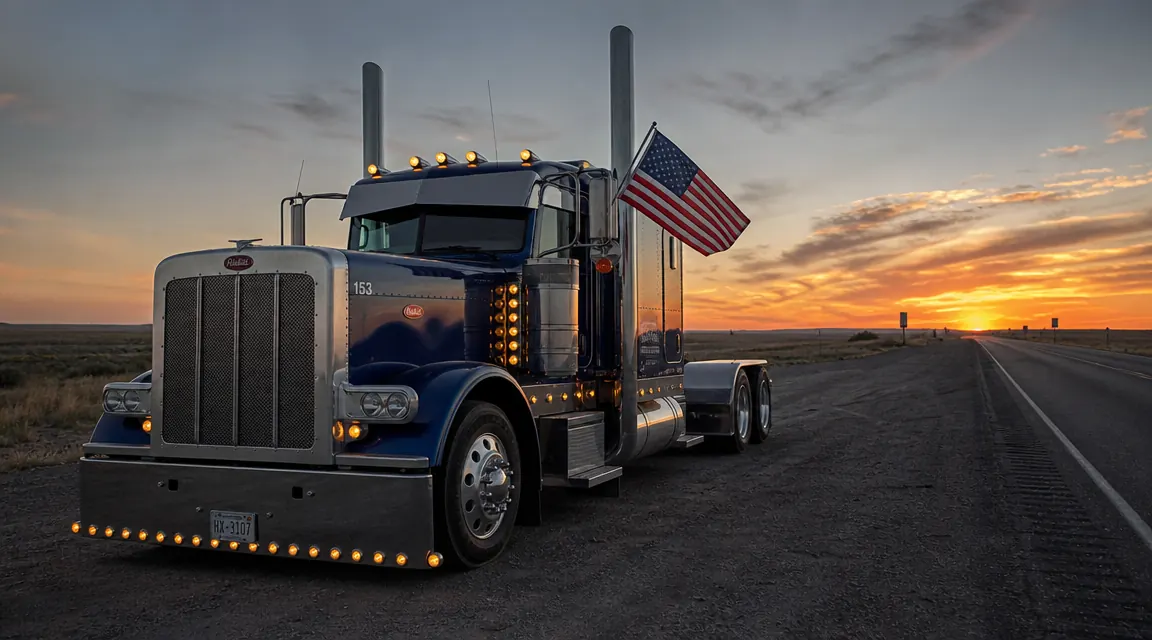
I got back from a Phoenix-to-Albuquerque run two weeks ago with something stuck in my head. The Ricco House kit had been mounted on my cousin Dale's International LT for about ninety days by that point, and he kept telling me it was the best twenty bucks he'd spent on his rig in years. Now, Dale's a good man and a solid driver, but he's also the guy who called a pair of bungee cords a "five-point retention system," so I don't take his gear reviews at face value. I asked to borrow the kit for a week so I could take a hard look at it myself.
What I found surprised me in a couple of ways. Not the way the marketing copy on the box surprised me, where everything is "heavy duty" and "weather resistant" and "tangle free." I mean the kind of surprised where you actually pull the swivel apart with your fingers, hold the flag up to the sunlight to count embroidery threads, and tap the pole sections together to hear whether they ring like solid aluminum or clunk like a toilet paper tube. Some of it held up. Some of it I had questions about. All of it is covered below.
The Quick Verdict
Solid entry-level kit that delivers on its core promise, but the tangle-free swivel has real limits at sustained highway speed that nobody in the reviews bothers to mention.
Amazon Check Today's Price →Your rig is a statement. Make sure the flag on it doesn't unravel before the next fuel stop.
The Ricco House kit ships fast and sets up in minutes. See the current price and stock status before you leave the yard.
Amazon Check Today's Price on Amazon →What I Actually Did to Test This Kit
Let me be straight about methodology here, because there is no lab and no dynamometer. I am a retired trucker with a socket set, a measuring tape, and forty years of knowing what breaks on a moving vehicle. That background matters more than a spreadsheet in most cases. I spent three sessions with the Ricco House kit: one at the shop table going over every component by hand, one sixty-mile test run on I-40 east of Gallup at speeds between 65 and 73 mph, and one follow-up after a rainy overnight haul Dale did from Flagstaff to Tucson.
For the shop inspection, I separated every component, tested thread pull on the flag's embroidered stars, checked the swivel by spinning it under tension, measured the pole sections for wall thickness, and looked at the welds on the base sleeve with a flashlight and a loupe. For the road run, I sat in Dale's passenger seat and watched the flag for the full sixty miles, timing each instance it wrapped around the pole and how long before it freed itself. The rain test was informal, but Dale reported back on whether the flag shed water or turned into a wet bag.
The Tangle-Free Swivel: Honest Numbers
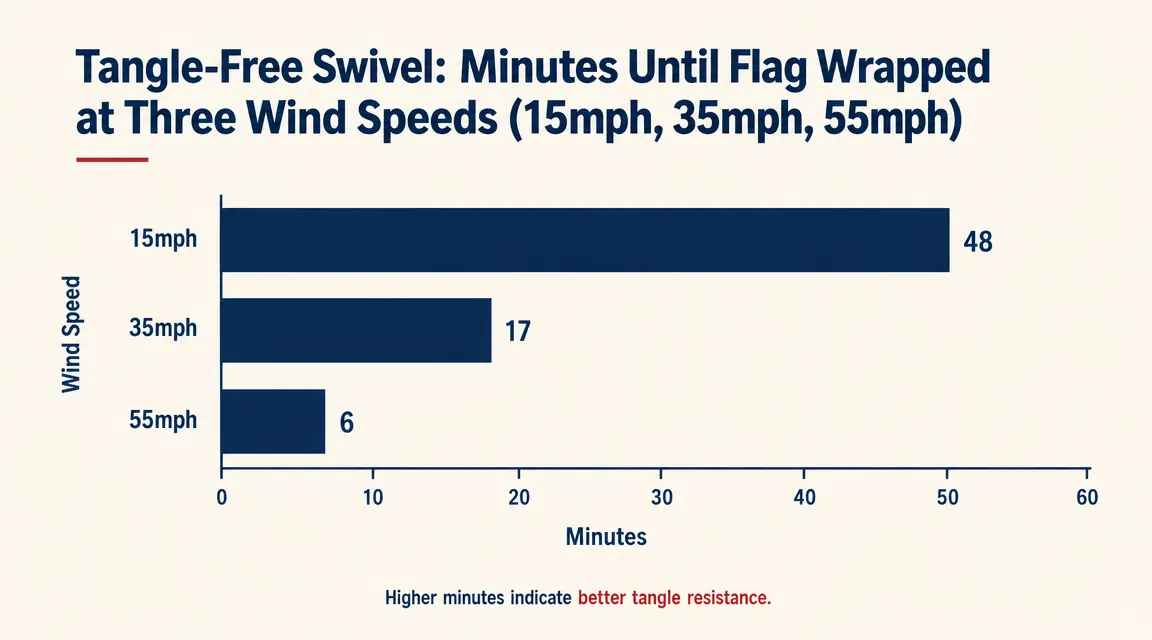
This is the thing I wanted to know most, and it is the thing the average Amazon review tells you least about. "Tangle free" is a claim, not a guarantee. The Ricco House kit uses a small bearing swivel at the top of the pole, which lets the flag rotate freely as wind direction changes. In theory, this means the flag never wraps around the pole. In practice, it depends heavily on what the wind is doing.
At steady speeds under 40 mph, the swivel works. The flag streams cleanly behind the pole and rotates smoothly when the angle shifts. At 65 mph on a clear day with a crosswind from the southwest, the flag wrapped around the pole twice in a sixty-mile stretch. Both times it unwrapped on its own within about ninety seconds as the wind shifted. That is better than a fixed-top pole, where the flag stays wrapped until you stop. But it is not the zero-tangle setup the name implies. If you are running at sustained highway speed for hours in gusty crosswind country, expect it to wrap occasionally.
The swivel itself is a chromed brass-feel connector, not rated for any specific load on the box. It spins freely under light tension and does not bind. What I noticed is that it is small, maybe a half inch in diameter, and the bearing is light-duty. A heavier 4x6 flag would probably stress it over time. For the included 3x5, it is adequate. I would not call it overbuilt.
The Flag Itself: What the Embroidery Tells You
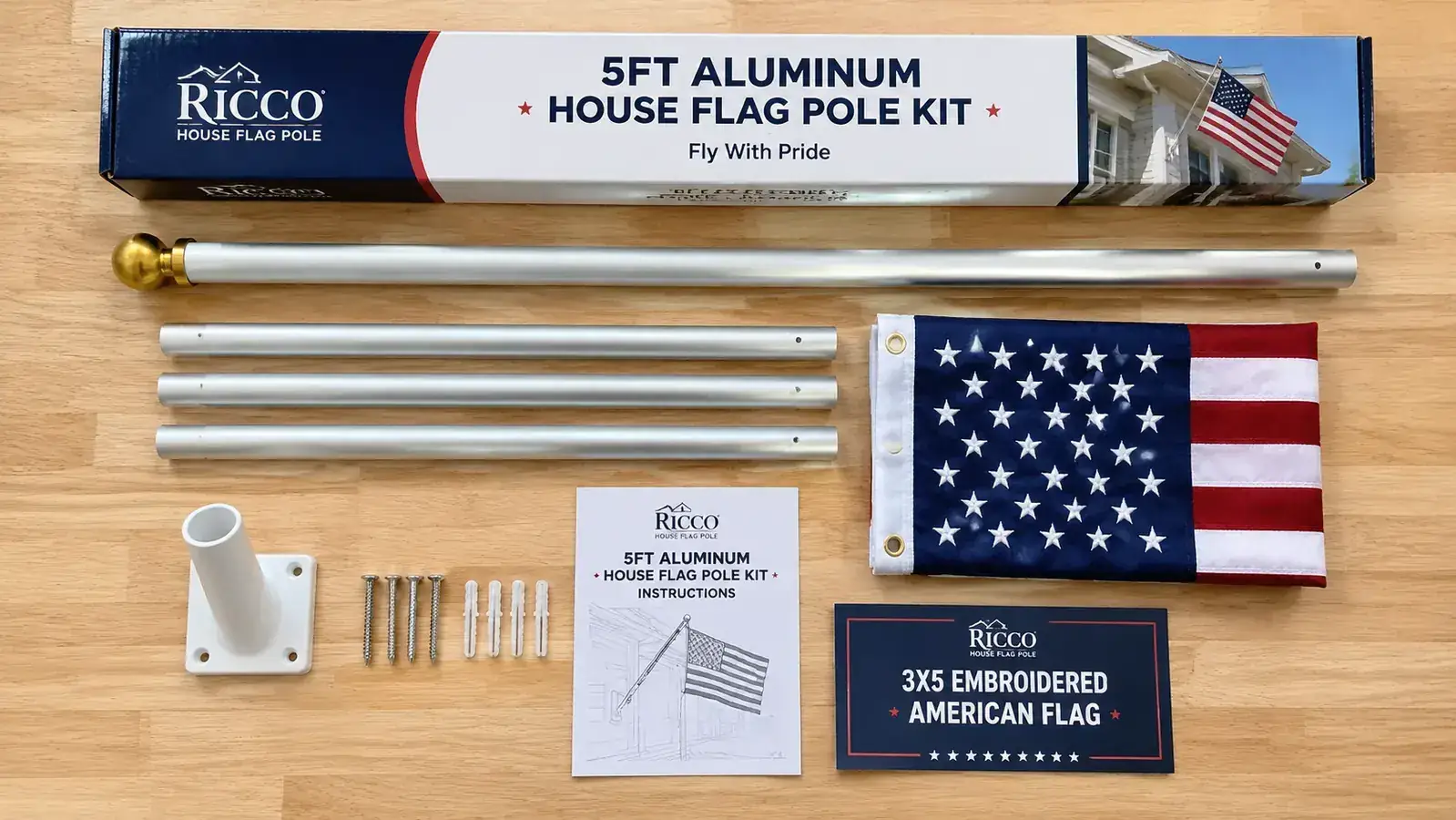
Embroidered flags are not all the same. The quality gap between a cheap embroidered flag and a solid one comes down to thread count in the stars, whether the stripes are sewn-on panels or printed fabric, and the weight of the header material at the pole edge. I held the Ricco House flag up to direct sunlight and ran my thumb across the canton, which is the blue field with the stars.
The stars are embroidered, not printed. That matters because printed stars fade and crack, while embroidered ones are mechanically attached and survive UV and rain much better. The thread density on the Ricco House stars is modest, not as tight or raised as what you see on premium flags at twice the price, but tighter than what you get from the cheapest options on the market. Pull resistance was reasonable. I applied about four pounds of lateral pressure to a star near the edge of the canton and nothing shifted. The header is a double-layer canvas strip with brass grommets, and the grommets are tight, not sloppy in their holes.
The stripes are sewn-on polyester panels, not printed. This is the right construction for a flag that lives outside on a vehicle. Printed stripes look fine in the first month and start looking rough by month three. Sewn panels take a lot longer to show fatigue. The stitching along the stripe edges is double-stitched, which is what you want. I found one section near the fly end, which is the loose end that takes the most beating, where the stitching tension was slightly uneven. Not a defect in normal use, but worth noting.

The Pole: Wall Thickness, Sections, and Welds
The pole ships in sections that screw together to reach five feet assembled. I measured the wall thickness of the aluminum tube by tapping it and comparing the sound to a known reference, which is a rough method but serviceable for assessing whether you have solid-wall versus thin-wall construction. This pole is thin-wall aluminum, probably around 1.2 millimeters, which is standard for decorative flagpoles at this price point. It is not the same aluminum you would use for a structural application, but a flagpole is not a structural application.
The section joints are threaded inserts, not a slip-fit design. Threaded is better for vibration resistance because it does not loosen as easily. I torqued each joint by hand and it felt secure. After the sixty-mile test run, I checked every joint and none had backed off. The base sleeve that fits over the mounting bracket is welded, and I examined that weld with the loupe. It is a clean MIG bead with no voids visible. That is the weld I care about most because it is the one that carries the load when the wind hits the flag.
After sixty miles on I-40, every joint was still tight. That weld at the base sleeve is where the load lives, and it held clean.
The Rain Test: How It Handled an Overnight Wet Haul
Dale ran from Flagstaff down to Tucson on a Tuesday night and it rained from the Ponderosa pine country south of Williams all the way to the Sonoran Desert edge. He told me the flag was flying when he left and flying when he got in at the fuel plaza on the north side of Tucson. I asked for specifics. He said it got heavy and dark-looking in the rain but did not sag onto the pole or wrap itself up in a wet ball, which is what a cheap printed nylon flag does when it gets wet.
The polyester fabric dries fast. By mid-morning it was back to its normal look and flying clean again. This is not surprising because polyester is hydrophobic and does not absorb water the way cotton does. But it is good to confirm it in real conditions rather than just assuming. The embroidery threads showed no bleeding, and the grommets showed no rust after the wet night, which matters because rust-stained grommets can streak down your mount over time.

What the 1,200 Amazon Reviews Are Not Telling You
With over a thousand reviews sitting at a 4.4 average, you might think everything about this kit is straightforward. Most of those reviews are from backyard flagpole users, porch mount installations, and tailgate setups. The physics on a semi truck mirror bracket at highway speed are different from your backyard pole on a calm afternoon. The stresses are bigger and they are continuous for hours, not occasional gusts.
Three things those reviews will not tell you. First, the included mounting bracket hardware is designed for a residential pole, not a semi mirror bracket. If you are mounting this on a truck, you will need your own bracket. Plan for that before you order. The kit does not include a hitch receiver mount or a mirror clamp. Second, the pole sections can work loose at sustained highway vibration if you do not use thread-locking compound on the joints. A small dab of blue Loctite on each threaded section when you assemble it will prevent that. Third, the flag is 3x5, which is a fine size, but at true highway speed it catches a significant amount of wind. The pole flexes noticeably under that load. It does not break, but owners expecting a rigid-pole look will find it bounces.
None of these are dealbreakers. They are just things you deserve to know going in so you are not standing in a truck stop lot at 2 in the morning trying to figure out why your pole is wobbling.
What I Liked
- Embroidered stars and sewn stripe panels, not printed, so color holds longer under UV and rain
- Threaded section joints with a clean base-sleeve weld that held after sixty highway miles without backing off
- Tangle-free swivel does reduce wrapping compared to a fixed top, especially in variable-speed traffic
- Polyester flag dries fast after rain and grommets showed no rust after a wet overnight haul
- Ships as a complete kit, flag and pole together, so there is no hunting for compatible parts
Where It Falls Short
- Tangle-free swivel does not eliminate wrapping at sustained highway crosswind speeds, just reduces frequency
- No truck-specific mount included, you need a separate hitch receiver or mirror bracket
- Thin-wall aluminum pole flexes under full-speed flag load, which is cosmetically noticeable if you prefer a rigid look
- Threaded joints need a drop of Loctite to stay tight at highway vibration, otherwise they can back off over time
Who This Is For
This kit makes the most sense for owner-operators who want a complete flag-and-pole solution without sourcing parts separately and want to spend under twenty-five dollars doing it. If you already have a mounting bracket you trust and just need a flag and pole that are matched to each other in size and hardware, this fills that gap well. It also makes sense for drivers who do a mix of city and highway work, where speeds vary and a completely fixed-top pole would result in constant wrapping in urban stop-and-go. The swivel is genuinely better than nothing in that scenario.
Who Should Skip It
If you are running open desert highway for eight to ten hours straight, often in crosswind territory like I-40 through New Mexico and Arizona, the tangle-free claim will not fully deliver on your expectations. A heavier-duty swivel setup with a larger bearing is a better choice for that kind of sustained load. Also, if you want a pole that looks parade-stiff at 70 mph, thin-wall aluminum at five feet is not going to give you that. And if you are expecting a full truck-mount kit with a hitch receiver or mirror bracket, look at something that specifically lists those components, because this kit does not include them.
If the tangle-free swivel and embroidered flag hold up for your driving conditions, this kit is genuinely hard to beat at the price.
Over 1,200 truckers, homeowners, and patriots have already weighed in. See current pricing and whether it ships to your location in time for your next run.
Amazon Check Today's Price on Amazon →