

I have been around mounting hardware my whole working life. Thirty years on the road means you learn real fast which piece of gear holds and which one rattles itself apart on I-70 somewhere between Salina and Abilene. So when my buddy Clete over at the Pilot in Joplin told me he lost his flagpole off a cheap antenna bracket somewhere on I-44, I started paying attention to the hardware question seriously. I picked up the UniExtra hitch mount for a 2-inch receiver and made a deal with myself: I would install it, run it hard, and then pull it off and look at every thread and every contact surface before I wrote a word about it. That is what this review is.
Most reviews on a product like this say something along the lines of 'fits great, easy install, flag looks awesome.' That is not wrong but it does not tell you what you need to know before you trust it at 70 miles per hour with a 3x5 nylon flag generating about the same drag as a small parachute. I am going to tell you what nobody else bothers to say.
The Quick Verdict
Solid steel, honest construction, with one fixable weakness in the clamping screw design. Worth the price if you know how to set it up right.
Amazon Check Today's Price →Your flag deserves a mount that doesn't disappear into a ditch at mile marker 200.
The UniExtra hitch mount is built from real steel, fits any standard 2-inch receiver, and ships with Prime. Check availability before your next run.
Amazon Check Today's Price on Amazon →What the Mount Actually Is
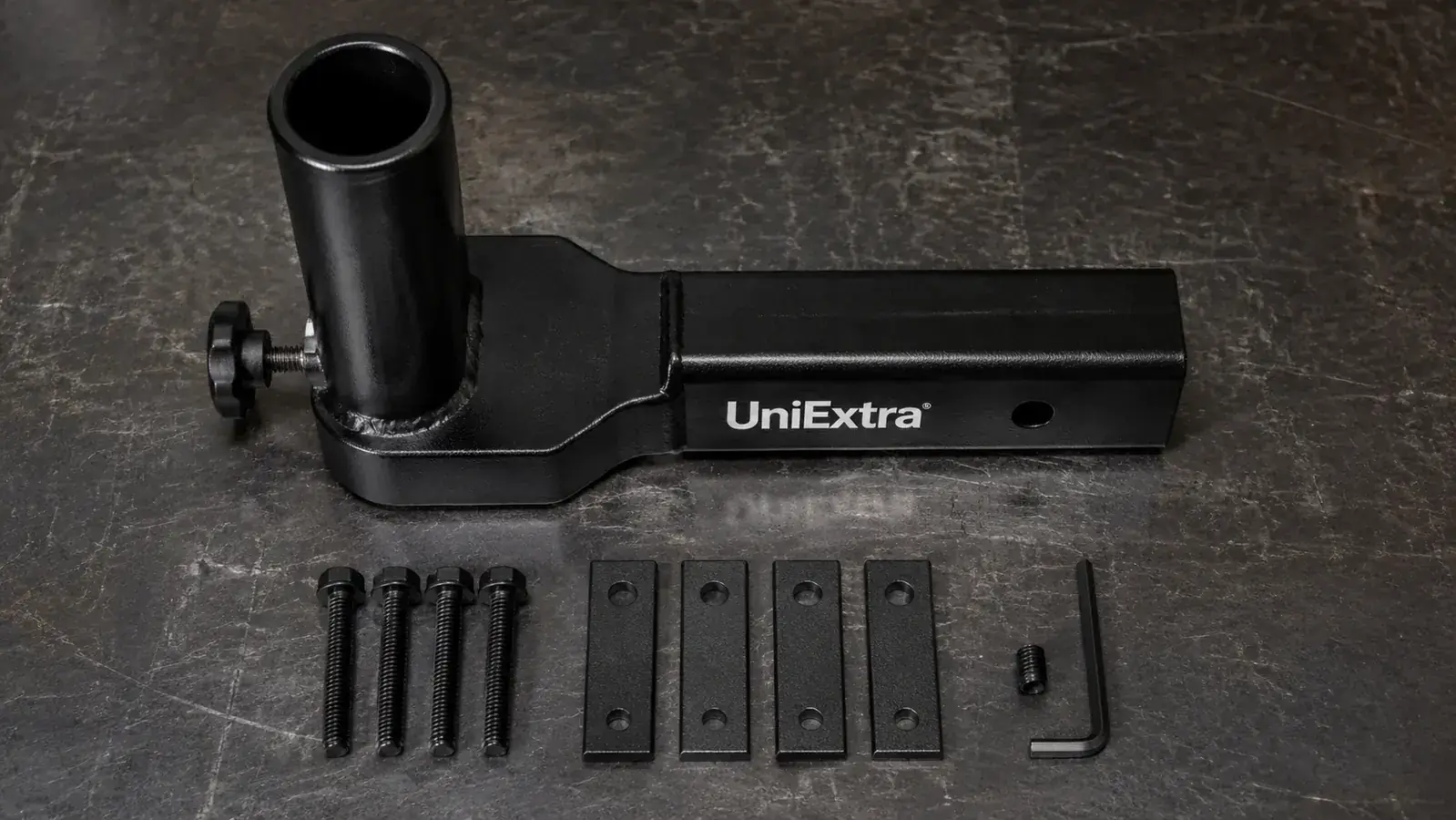
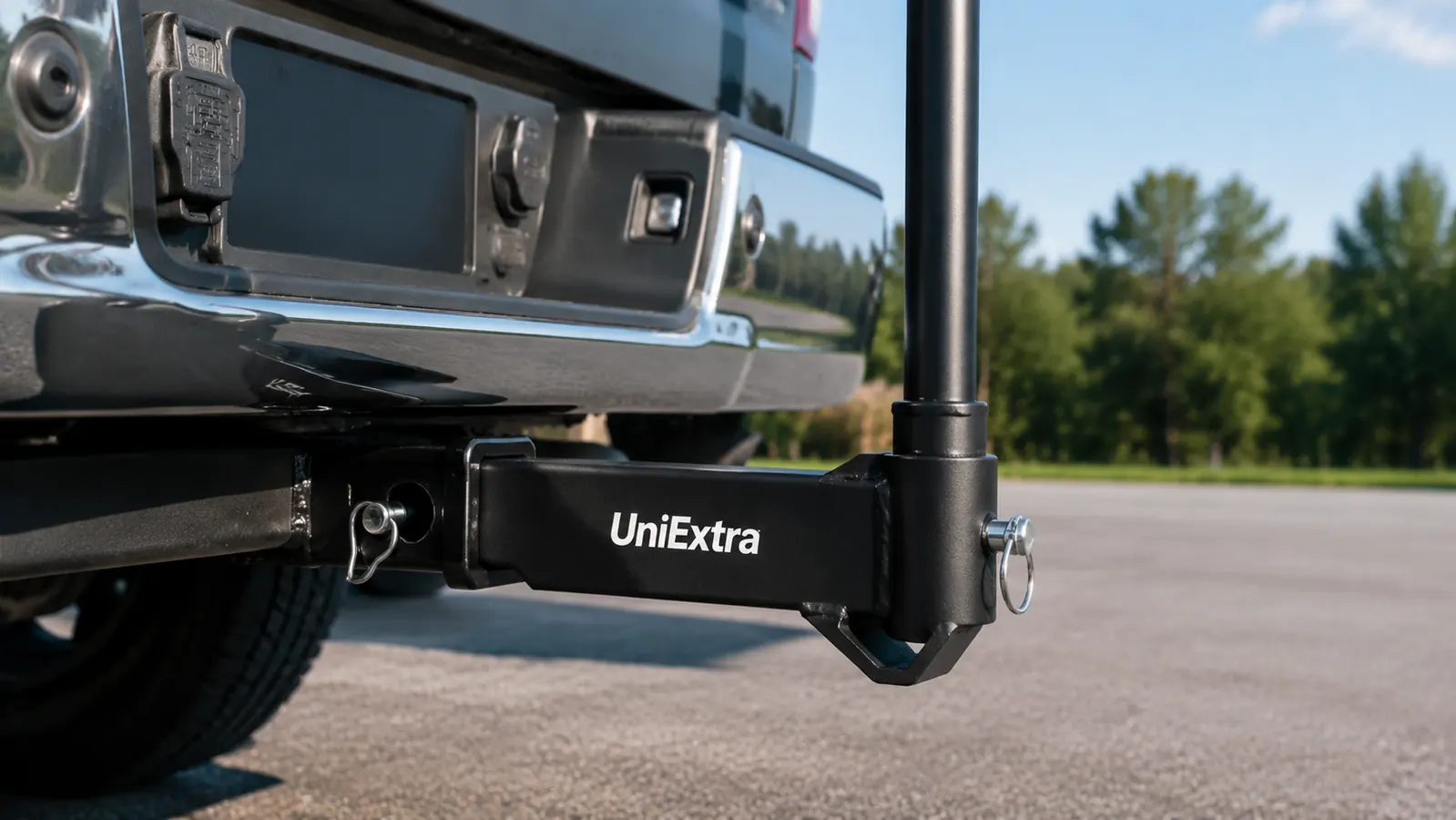
The UniExtra hitch flagpole holder is a steel tube with a collar that slides into your 2-inch receiver hitch and locks down with two clamping screws. The pole socket at the top accepts a standard flagpole tube, which you then tighten with a second pair of set screws. The whole assembly is powder coated flat black. There are no welds on the outside that look questionable and no cast plastic parts pretending to be structural. This is a simple piece of hardware doing a simple job, and that simplicity is mostly a virtue.
The mount ships with the screws already threaded into their collars, which is a small thing but it tells you the manufacturer has done this before. You are not fishing around looking for a bag of loose hardware. The screws themselves are standard hex-head bolts, which means any 3/8-inch wrench you have in your cab tool roll will work. That matters when you are tightening things down at a fuel stop with diesel-slick hands at midnight.

The Hardware Inspection: What I Found After the Miles
Here is the part nobody writes about. After running this mount through roughly 10,000 miles across Oklahoma, Kansas, and Nebraska, mostly at 65 to 70 miles per hour with a 3x5 American flag up, I pulled it off the receiver and put it on a bench under a work light. I looked at the thread engagement on both sets of screws, checked the powder coat for wear points, and wiggled everything to feel for slop.
The lower clamping screws, the ones that lock the mount in the receiver, showed zero thread damage. The hex socket had some rounding from repeated tightening with my wrench, but the threads in the collar itself were clean. The contact pads on the screw tips, the little nylon tips that bite against the inside wall of your receiver, were worn down about halfway. That is expected wear. UniExtra does not sell replacement tips separately that I could find, which is a minor annoyance, but a wrapped piece of electrical tape on the screw tip will extend the life fine.
The upper pole-socket screws are where the story gets more interesting. I found those had backed out about a quarter turn each. Not enough to drop a pole, not even close, but enough that I could wiggle the pole slightly if I grabbed it and tried. That movement at the base adds up to real vibration stress on the flag grommets over time. The fix is simple: a dab of removable thread-locking compound on those screws when you first install. That costs about two dollars and makes the problem go away permanently.
One more thing I checked was the inside bore of the pole socket itself. After 10,000 miles there was visible wear scoring on the interior surface from the pole shaft rotating slightly under vibration. Nothing structural, but it tells me the socket fit is not tight enough to fully prevent micro-rotation between the pole and the mount. If you are the type to check things periodically, re-snug those upper set screws every 2,000 miles or so. Takes thirty seconds with a wrench.
The Flag Angle Question: What Most Drivers Get Wrong
The UniExtra mount holds the pole at a fixed vertical position in the socket, meaning the pole angle is up to you. A lot of guys just stick the pole straight up, which looks right when you are parked. It is not right when you are rolling.
At highway speed, a flag on a vertical pole wants to wrap back around the pole itself. The wind catches the leading edge and folds the flag back so it beats against the pole. That beating destroys the grommet attachment points over time, and it also looks terrible. The correct setup for a hitch-mounted pole on a semi is to tilt the pole backward somewhere between 10 and 20 degrees from vertical. This lets the flag fly outward and behind rather than collapsing against the pole.
The UniExtra mount does not have a built-in angle adjustment. You get the angle you get from how your receiver sits and how tight you lock things down. On my Freightliner, the rear receiver is close to level, which meant the pole came up very close to vertical. I added a small rubber wedge behind the mount tab inside the receiver to create about 15 degrees of tilt. This is a common field fix and it works. I would not call this a flaw in the UniExtra design specifically since most hitch mounts share this limitation, but it is something to know before you bolt it on and drive away expecting the flag to fly perfectly.
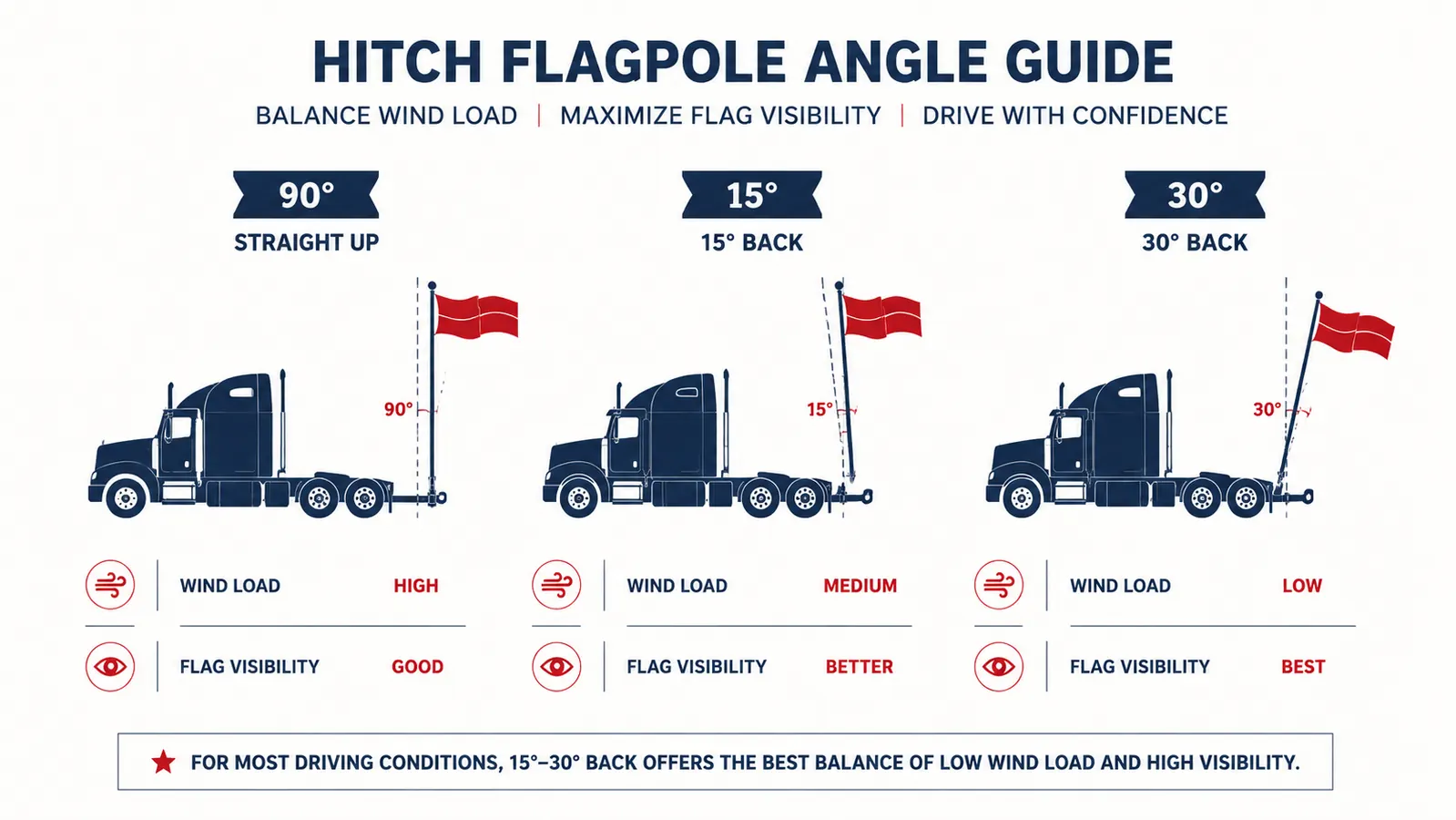
At highway speed, a flag on a vertical pole wants to wrap back and beat itself against the pole. Tilt it 15 degrees backward and that problem disappears.
Steel Quality and the Powder Coat: Honest Take
The steel is not chrome-moly and nobody is claiming it is. It is standard mild steel tubing, adequate for the job. The wall thickness feels honest, not sheetmetal thin. When I knocked on it, it rang with the dull thud of something with real mass rather than the pinging sound of hollow lightweight tubing. I have seen mounts that felt like they belonged on a mailbox, and this is not that.
The powder coat took the 10,000-mile run with one small chip near the receiver collar where my socket wrench had slipped during initial tightening. That chip is my fault, not the finish. The rest of the coating looked close to new. There was a little surface rust developing in the chip site after exposure to Kansas rain, which tells you the base steel is not galvanized underneath. If you chip the powder coat you need to hit it with a rust inhibitor or touch-up paint within a reasonable time. Not a dealbreaker, just real-world maintenance.
On the inside of the receiver collar, where the metal contacts your hitch, there is no sleeve or liner. Metal on metal. Over time that will wear both surfaces slightly, which is true of virtually every hitch-insert product on the market. If you are removing and reinstalling this mount frequently, a thin smear of anti-seize on the insert shaft will prevent galling and make pulls easier in cold weather when the metal contracts and things can bind up tighter than you expect.
Install Tips That Will Save You a Headache
I want to cover install specifics because the included instruction sheet is thin. First, before you insert the mount into your receiver, wipe out the receiver bore with a rag. Road grit inside the receiver acts like an abrasive between the mount collar and the receiver walls. A clean receiver means more consistent clamping force and less long-term scoring. Second, do not overtighten the lower receiver clamping screws. The nylon contact tips compress and crack if you gorilla them. Snug is enough. If you feel the screw stop turning easily and the mount does not wiggle, you are done.
Third, and this is the one most people miss: insert your flagpole into the socket before you tighten the upper set screws. Thread the flag onto the pole first so the weight and balance of the assembled setup are present when you make your final tightening pass. A bare pole sits differently in the socket than a loaded one. Tightening around the assembled weight helps prevent the micro-rotation I described earlier. It takes an extra three minutes during install and saves you maintenance time over the life of the mount.
What the 4.4 Stars Are Actually Telling You
The UniExtra has a 4.4-star rating across 686 reviews as of the time I am writing this. That is a meaningful sample. When I read through the low-star reviews, the pattern is predictable. Almost all of them come down to one of three things: the mount slid in the receiver because the buyer did not tighten the clamping screws enough, the pole socket screws backed out because the buyer did not use thread locker, or the flag wrapped around the pole because the buyer ran it straight vertical at highway speed. All three of those are installation and setup issues, not product defects.
The high-star reviews consistently say the same thing: good steel, easy install, holds tight. Those buyers figured out the setup. The point I am making is that this product has a meaningful learning curve that the instructions do not fully explain, and if you go in without knowing what to expect, you might end up writing a two-star review about a problem you caused yourself. Read this article first and you will have a better experience than about 20 percent of the buyers who left negative feedback.
The One Situation Where I Would Not Use This Mount
If you pull into a loading dock or distribution center with overhead clearance restrictions regularly, you need a system for flagpole removal that takes under two minutes. A hitch mount actually helps here because you can pull the pole out of the socket without removing the mount itself. However, that only works cleanly if your pole has a clean bottom end that slips in and out. Some aftermarket flagpoles have locking rings or cotter pins at the base that make removal slower. Budget a minute to test the pole removal before you need to do it in a hurry at a dock gate.
I also would not use this, or any hitch mount, on a truck with a receiver that has significant play or wear. A sloppy receiver means the mount will have baseline wobble regardless of how tight you run the clamping screws. If your receiver has more than about three-sixteenths inch of slop side-to-side, the mount will telegraph that vibration straight up the pole to the flag. You will shred a flag faster than you should, and the mount screws will work loose faster too.
What I Liked
- Genuine steel construction, not plastic-core with a metal sleeve
- Standard hex hardware means any wrench in your tool roll works
- Ships with screws pre-installed, no parts hunting on install day
- Powder coat holds well against weather when undamaged
- Receiver collar fits true 2-inch openings without shimming
Where It Falls Short
- Upper pole-socket screws need thread locker on install, not mentioned in instructions
- No angle adjustment built in, requires a field wedge for proper flag flight
- Nylon screw tips wear over time and cannot be ordered as replacements
- Bare steel under the powder coat rusts quickly at chip sites
Who This Is For
This mount is built for the owner-operator or OTR driver who wants a permanent-ish flag setup that does not require drilling holes in the cab. If you have a 2-inch rear receiver, which most Class 8 trucks do, you are done with the compatibility question. The UniExtra gives you a real steel platform for a flagpole that will stay put at highway speed provided you install it correctly. It is also a reasonable choice if you run a pickup or a day cab with a trailer hitch and want to fly the flag during a parade run or on a holiday weekend without committing to a permanent mount.
Who Should Skip It
If your receiver is worn out or loose, address that first. This mount will not fix a sloppy hitch, and a flagpole bouncing around at 70 miles per hour because of receiver slop is a hazard. Also skip this if you are flying a very large flag, say 4x6 or bigger. The pole socket is sized for standard flagpole diameters and the clamping force is adequate for a 3x5 flag, but a larger flag creates more drag and more lever force on the socket joint. For oversized flags on a semi, a dedicated bracket mount welded or bolted to a frame crossmember is the right answer. The UniExtra is not that product and does not claim to be.
You can read more about how this mount stacks up against other mounting approaches in the full comparison of hitch mounts versus bed-side mounts for semi trucks, and if you want the long-term wear report across more miles, the long-term UniExtra hitch mount review covers the six-month findings in detail.
If you know what to tighten and how to angle it, this mount does the job without excuses.
The UniExtra hitch flagpole holder fits standard 2-inch receivers and ships ready to install. Add a drop of removable thread locker on the pole-socket screws and you will not be back here reading about why your pole is wobbling. Check current availability on Amazon.
Amazon Check Today's Price on Amazon →